
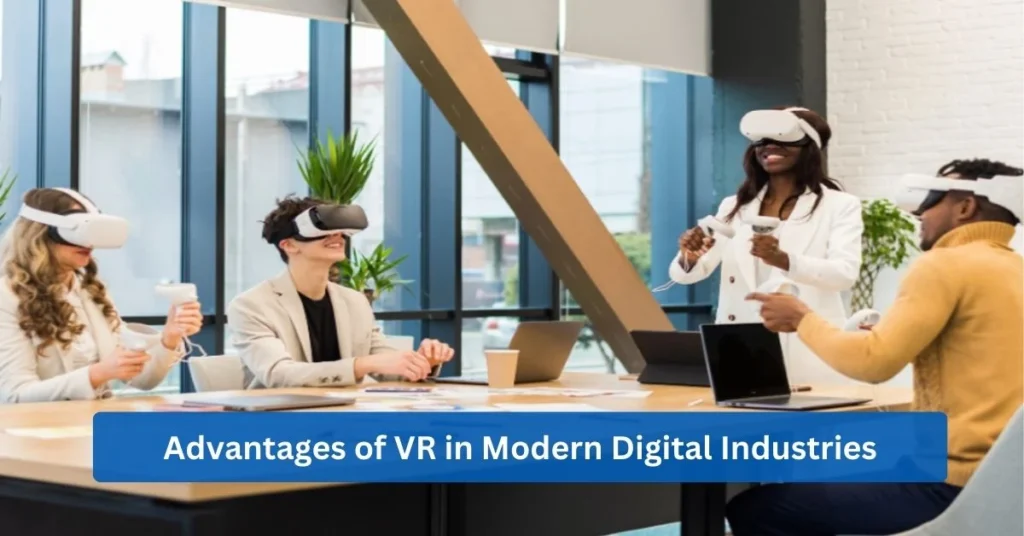
Advantages of VR in Modern Digital Industries
The advantages of Virtual Reality Technology we have today provide learning experiences, skills, and cost-friendly simulations, among others. With today’s technology, the benefits of VR go beyond simple gaming and entertainment perks. It even takes part in training employees, product design processes, education, and customer engagement.
Understanding these virtual reality benefits becomes significant as digital transformation advances, especially for organizations to up their game and stay competitive. Let this blog inform you on the advantages of virtual reality, what it is, how it works, and why it is important. This blog will also give you knowledge on how virtual reality is being used across different industries, its limitations, and how it will take part in future computer-generated environments.
What Is Virtual Reality Technology
Virtual Reality (VR) represents a type of modern technology that creates an environment generated from a computer in which the user is able to engage with digital elements that are considered to be life-like.
It uses headsets and motion tracking to add more elements to a simulated world. It is primarily aimed at delivering an experience that can be immersed in by users that is close to the physical world.
How Virtual Reality Technology Works
VR Technology operates by recreating a real-life 3D surrounding using hardware and software. VR headsets are provided with 3D visualization and motion tracking sensors that track head and body movements. Combined, the created digital world can react to user input in real time.
Other components like controllers, haptic feedback, and spatial audio are used for VR, which allows a better and more realistic sensory experience.
History of Virtual Reality Technology
According to a study by Cipresso et al. (2018), the concept of VR was first formulated in the 1960s, while the tools appeared in the 1980s. The gap of 20 years was spent researching processes, effects, and applications of VR, which produced thousands of scientific papers.
Now, Virtual Reality technology has come a long way, and we now experience VR in a way different from how it was first conceptualized back then. Oculus Quest and HTC Vive are also devices that brought VR into mainstream industries over time. This literature provides more detail on the history of VR: https://pmc.ncbi.nlm.nih.gov/articles/PMC6232426/

Key Benefits of Virtual Reality Technology
Immersive Learning Experience
One of the main advantages of virtual reality technology is the ability to provide an immersive learning experience to its users. Users can enjoy a simulated environment that VR places them in, which improves their focus and deepens their understanding.
This is a big change from having to observe from the outside and simply watching from a computer screen to learn.
The education sector can especially benefit from this technology. This technology allows students to learn from an immersive experience that improves knowledge retention and enables them to explore complex concepts visually and interactively.
Enhanced Training and Skill Development
Virtual reality technology enables hands-on training with better user interaction without real-world consequences. With VR, users undergoing training can practice their skills in a controlled virtual world. This is significantly valuable to technical, medical, and high-risk roles like the healthcare industry.
Consequently, training with VR leads to faster skill acquisition. Users can gain more confidence before the actual performance of tasks in real situations.
Cost-Effective Virtual Simulations
Despite initial setup costs to consider, investing in simulation technology offers reduced long-term expenses. Companies can expect lower costs in the long run as they lessen the need for physical equipment, travel, and training facilities. Virtual simulations can be reused and updated easily.
In return, virtual reality benefits are attractive, especially for large-scale training programs, because of long-term measurable returns.
Safe Environment for Risk-Based Training
Another key advantage of virtual reality is the safety it provides. VR allows users to practice tasks that are usually dangerous when done in real life within a simulated environment. Mistakes become learning tools rather than incidents that can be costly.
The healthcare industry and aviation heavily rely on VR for training. With VR training, training feels more realistic and has zero risk. As a result, users are more confident to apply their learnings to doing the real thing with patients and flights.
Improved Visualization and Design Capabilities
Another core advantage is 3D visualization. Designers can visualize digital models in full scale before actual production. It improves planning and reduces costly design errors. Additionally, decision-making is made quicker and more accurately.
Better User Engagement and Interaction
Advanced user interaction, which also allows users to engage directly with objects and environments, is also one of the virtual reality benefits. Instead of repeatedly clicking or scrolling, VR creates a more natural experience.
Better user interaction also leads to higher engagement. This also improves learning and retention.
Remote Collaboration through Virtual Reality
VR also strengthens collaboration despite being remote through virtual worlds. Teams can meet inside these virtual worlds regardless of distance, allowing effective remote work.
Unlike video calls, VR supports spatial presence. Remote collaboration still feels realistic and improves productivity.
Real-Time Experience in Virtual Environments
Real-time simulation allows immediate feedback that enables users to see the results of their actions instantly. In return, users understand better and improve decision-making.
This real-time experience through simulation is especially critical for training and design applications. It improves realism and accuracy.

Benefits of Virtual Reality in Different Industries
Virtual Reality in Education
In the education sector, how students learn is completely transformed with the benefits that virtual reality offers. Lessons are more interactive and immersive with VR. Concepts that are usually difficult to teach to students become easier to understand with the help of VR.
With VR, students can freely explore labs and other environments without the risk and without the need for constant supervision. Virtual Reality improves engagement and retention.
Virtual Reality in Healthcare
In the healthcare industry, VR is mostly significant in training, therapy, and patient education. Medical professionals are given more confidence and with improved precision as they are able to practice procedures in realistic simulations.
These controlled environments enhance patient outcomes.
Virtual Reality in Gaming and Entertainment
One of the earliest adopters of VR is the gaming industry. With virtual worlds, players enjoy a more interactive experience with realistic movement and feedback.
Games with Virtual Reality (VR) also offer deeper emotional engagement. This is one of the competitive advantages of VR over traditional formats.
Virtual Reality in Real Estate
The real estate industry also uses VR for virtual property tours. They can accommodate clients by using VR for them to explore properties remotely with immersive walkthroughs. It saves time and expands reach.
Unbuilt properties also become possible to visualize with VR. Decision making for clients becomes faster and more confident, even though the property they are going to buy has not been finished yet.
Virtual Reality in Business and Marketing
VR makes it possible to deliver interactive product experiences to businesses’ customers. Benefits of virtual reality include stronger brand engagement and improved customer understanding. Marketers can offer an experiential advantage to consumers.
Virtual showrooms and interactive demonstrations increase conversion rates as customers feel more informed and confident with the products businesses are selling.
Virtual Reality in Military and Aviation Training
Military and aviation heavily rely on simulation technology. Without risks involved, trainees can practice missions and procedures with the help of controlled virtual environments.
Moreover, scenarios can be repeated and adjusted easily, thus improving training efficiency.
Future Scope of Virtual Reality Technology
Emerging Trends in Virtual Reality
The world can expect lighter devices and improved displays from VR. Wireless VR headsets are emerging, which improve comfort and usability.
Additionally, social and enterprise VR platforms are expanding. Industries are more and more adopting this new technology.
Integration of Virtual Reality with Artificial Intelligence
With the use of AI also emerging, the combination of VR and AI creates even smarter visual systems. AI adapts experiences based on user behavior, making training and simulations more personalized over time. This integration improves user interaction and realism.
Role of Virtual Reality in the Metaverse
Virtual Reality (VR) is the center of the metaverse concept. It allows immersive access to shared digital space, which enables users to interact, work, and socialize inside persistent virtual worlds. As the metaverse grows, VR will serve as a primary interface, allowing new opportunities to emerge.
Conclusion
With virtual reality technology, the world can experience a more immersive simulation of the digital world, which also improves training, advances visualization, and enhances user engagement. Industries can also enjoy VR that offers them practical and measurable value that supports safer, smarter, and more efficient operations.
In the future, these core advantages of using virtual reality will continue to expand. With the emergence of AI, VR can integrate its capabilities with AI to enhance user engagement and provide a more personalized experience, allowing for broader industry adoption.
Organizations that embrace VR today will be capable of facing the future more confidently and with an advantage.
FAQ Virtual Reality Technology
What Are the Main Advantages of Virtual Reality Technology?
VR offers immersive experiences, realistic simulations, and better training outcomes. VR also enhances engagement and ensures safety.
Why Is Virtual Reality Important in Education?
Learning becomes more interactive and immersive with VR. Learners can better understand topics, even complex ones. Learning retention is improved.
What Industries Benefit Most from Virtual Reality?
Industries such as the education sector, healthcare, gaming, and real estate benefit most from VR. Any industry using simulation technology can also gain value from VR.
Is Virtual Reality Technology Expensive?
Initial setup costs can be high, especially when looking to purchase an advanced VR headset. However, long-term savings and decreasing prices improve affordability.
What Is the Future of Virtual Reality Technology?
The future includes AI integration, better hardware, and metaverse growth. VR technology will become more common across industries and for everyday use.