
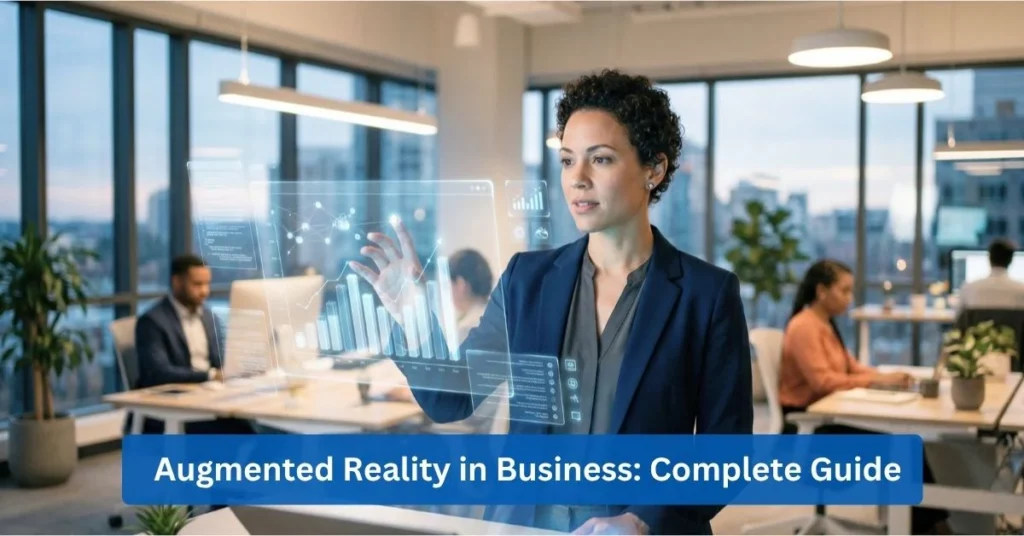
Augmented Reality in Business: Transforming the Future of Industries
AR is no longer game playing or entertainment but an effective technology that changes the modern-day world of industries. Today, augmented reality in the business enables companies to excel in terms of selling their products, training their employees, automating business processes and reaching customers. AR is becoming one of the primary drivers of digital transformation, whether it is through immersion in retail experiences to enable customers to see what they are buying or through the use of industrial maintenance aided through smart glasses and live guidance.
Modern organizations are embracing the use of augmented reality for business as a tool to enhance business to reduce operational expenses, increase efficiency, and create great experiences for customers that are memorable and unique in the competitive markets across industries. With the increased accessibility of technology, AR is no longer an experimental innovation but rather a business solution. This handbook will discuss the fundamentals of AR, its real-life applications and the means through which companies can develop a successful augmented reality strategy to initiate long-term growth and innovation.
What Is Augmented Reality in Business?
Augmented reality (AR) is a technology that imposes digital content (e.g., 3D objects, data, animations, or instructions) on the real world using smartphones, tablets, or wearables.
Augmented reality for business is the application of AR technology in business environments to optimize workflow, customer experience, marketing campaigns, and operations. Instead of substituting reality, AR adds more contextual digital information to reality in real time.
Businesses use AR to:
- Imagine products prior to purchase.
- Help technicians make repairs.
- Deliver immersive training
- Enhance inter-team coordination.

How AR Technology Works in Enterprise Environments
AR systems are based on a combination of several technologies:
- Computer vision recognizes the surfaces and objects in the real world.
- Sensors and cameras are monitored using sensors and cameras.
- 3D rendering engines generate digital overlays.
- Cloud computing facilitates real-time synchronization of data.
AR applications are typically connected to existing business systems in an enterprise setting (ERP platform, product database, or training software). This enables the employees to have live data when executing their tasks, hence making air for business both feasible and scalable to the business.
Difference Between Augmented Reality, Virtual Reality, and Mixed Reality
The awareness of what is different about immersive technologies will be applicable in explaining the place of AR in business:
- Augmented Reality (AR): Visually displays digital information on the actual world.
- Virtual Reality (VR): completely substitutes the physical setting with a computer simulation.
- Mixed Reality (MR): Unites the real physical world with digital worlds in which objects can interact with each other.
Although VR is the best option in the case of simulations, augmented reality and business applications are commonly needed as employees are not isolated from their physical environment and may be assisted with digital help.
Why Augmented Reality and Business Are Becoming Closely Connected
There are a number of reasons that are given for why adoption of AR is picking up:
- More smartphone and wearable device functionality.
- Pressure on immersive customer experiences.
- Homework and international work are required.
- Stress to lower the cost of operations.
Augmented reality offers an effective means of closing the gap between the digital and physical experiences as companies vie against one another through innovative approaches.
How Is AR Used in Business?
- AR for Business in Retail and E-commerce: One of the first to use augmented reality in business was through the use of it by retailers to minimize uncertainty in online shopping.
- Virtual Try-On Solutions: Virtual try-on tools enable consumers to inquire how a garment, accessories, cosmetics, or eyewear appears prior to buying. This enhances confidence in buyers and minimizes returns of products.
- 3D Product Visualization: Mobile AR applications allow customers to install life-sized digital products in their homes. This is a strategy adopted by furniture sellers, electronic brands, and car manufacturers to enable customers to imagine a size and fit.
- Interactive Shopping Experiences: AR in-store engagement can help a shopper navigate the store, showcase promotions, or activate interactive storytelling features to transform the shopping experience into experience.
Augmented Reality in Manufacturing and Industrial Operations
The use of AR in industrial sectors is increasing rapidly to enhance productivity and safety.
- Remote Assistance and Maintenance: Remote specialists can provide techs with real-time visual directions. The components are highlighted by AR, which minimizes errors and downtime.
- AR Smart Glasses for Technicians: Smart glasses will give the workers directions when fixing machines without the need to use their hands. This increases productivity and saves training.
- Workflow Optimization: AR shows step-by-step instructions in the direct view of a worker, which reduces errors and enhances quality control.
AR for Corporate Training and Employee Development
One of the most effective uses of AR for business.
- Immersive Onboarding Programs: Workplaces can be explored virtually to allow new employees to learn procedures in an interactive way, thus expediting the onboarding.
- Simulation-Based Learning: AR provides a means of realistic simulation of a complicated operation without the danger of equipment destruction or injury.
- Safety and Compliance Training: Augmented environments allow workers to practice emergency procedures or other dangerous scenarios safely, enhancing retention and compliance.
Augmented Reality in Marketing and Sales
In the digital realm, where digital marketing teams are competing to be heard, AR is helping them to create a presence.
- Interactive Product Demonstrations: Presentations of products can be done in 3D, and the sales teams can demonstrate to the customers immediately they can know the features of the product.
- AR Advertising Campaigns: When printed, print advertisements, packaging, and social media campaigns can be unlocked and create digital experiences that boost the engagement rates.
- Customer Engagement Through Immersive Experiences: The AR storytelling enables the brands to develop emotional relationships, inviting the customers to engage more closely.
AR Content for Corporate Events and Experiential Marketing
One of the fastest developing domains is AR content for corporate events.
- AR Trade Show Activations: AR booths allow companies to engage visitors with the use of digital products or walkthroughs and therefore draw more people.
- Product Launch Experiences: AR can be used to make dramatic product announcements as a digital version of a product is shown in a real-world location and makes a lasting impression.
- Branded Interactive Installations: Interactive installations are interactive storytelling and technology used to strengthen brand awareness at conferences and exhibitions.

Key Benefits of Augmented Reality for Business
AR presents quantifiable benefits that assist organizations in enhancing performance and consumer satisfaction. The enhanced customer experience and engagement are among the greatest advantages. AR turns passive users into active users as it enables customers to engage with the products directly, which makes the brand recall and customer satisfaction stronger.
AR also brings about higher conversion and sales. In case customers are able to see products in real-life scenarios, uncertainty is reduced, and they are able to make easy buying decisions. Moreover, the businesses can save on costs in training and operations since AR will reduce the necessity of physical prototypes, traveling, and repeated training and will assist employees to learn more quickly and commit fewer errors.
- Improved Customer Engagement and Experience: AR converts inactive audiences to active users. Products and experience are in contact with customers, which makes them more satisfied and remembrance of the brand.
- Increased Conversion Rates and Sales: Purchase hesitation reduces when customers have a better idea of the products as a result of better visualization of the products. Numerous companies claim to increase their conversion rates as a result of the introduction of AR experiences.
- Cost Reduction in Training and Operations: AR eliminates the use of physical prototypes, travel, and repetitive training. Employees develop quickly and commit fewer errors, thus saving the cost of operations.
- Competitive Advantage Through Innovation: Those companies that implement the augmented reality strategy at the first stage become pioneers in the industry. This differentiation will be able to attract customers, partners, and investors.
- Enhanced Data Visualization and Decision-Making: AR helps decision-makers to display intricate information in a spatial manner, which enhances comprehension and teamwork in the planning or analysis process.
Developing an Effective Augmented Reality Strategy
To develop an effective augmented reality plan, it is important to plan it and make it business-oriented. The initial phase is the evaluation of business requirements and objectives before venturing into AR technology. It is important that companies specify the goals they wish to accomplish, be it the enhancement of customer contacts, the cost of training, the output, or operational efficiency. A powerful augmented reality plan will guarantee that the application of technology is aligned to quantifiable corporate impacts instead of trial without purpose.
Second, companies need to find the appropriate AR application. Not all workflows are improved under the influence of AR, and the business should concentrate on high-impact spheres like the improvement of customer experience, intricate technical tasks, and training or educating employees. A small pilot project will help companies to test the effectiveness, provide feedback, and promote smoother adoption among the teams.
Assessing Business Needs and Objectives
Companies need to outline goals before investing in AR. Are they enhancing customer interaction, lowering the training expenses, or creating more operational efficiency?
The effective augmented reality strategy follows the strategy of matching the adoption of technology to quantifiable business results.
Identifying the Right AR Use Case
AR is not beneficial to all processes. The areas that businesses should focus on include high-impact areas, which would include.
- Improvement of customer experience.
- Complicated technical processes.
- Training and education
Choosing the Right AR Platform and Technology
The choice available to the companies is between mobile AR applications, web-based AR, or wearable devices. These factors are scalability, the ability to integrate, and ease of access by the user.
Budgeting and Cost Considerations
Costs vary depending on:
- Development complexity
- Hardware requirements
- Content creation
- Maintenance and updates
However, long-term savings often offset initial investments.
Measuring ROI of AR for Business
The key performance indicators are:
- Engagement rates
- Training completion time
- Error reduction
- Increase in sales conversion.
Following up on measurable results will guarantee further maintenance of AR projects.
Challenges of Implementing AR in Business
Even though the benefits of augmented reality are numerous, there are also several issues that companies should consider when implementing the technology. Challenges here are the technical, financial, and organizational barriers that could impact effective AR implementation. Such challenges may impact the performance of the systems, adoption by the employees, and the general investment.
The awareness of the potential barriers can help companies to develop effective solutions before they are implemented. The companies can recognize the limitations related to hardware capacity, the cost of making a development, and staff education, data privacy, and risk mitigation, which will help them streamline the integration process. Addressing such concerns promptly, the businesses ought to be capable of exploiting the potential of AR to its fullest without compromising their operations in an ineffective and unsustainable way.
- Technical and Hardware Limitations: However, despite the progress, there are certain limitations to the battery and field-of-view of certain AR devices, as well as processing issues.
- Development Costs and Investment Barriers: Development of quality AR experiences should involve particular expertise in 3D modeling, UX design, and software engineering.
- User Adoption and Training Issues: The first resistance may be the resistance of employees to new technology. Onboarding and user-friendly design are essential in the implementation.
- Data Security and Privacy Concerns: AR applications have the tendency to gather spatial and visual data, which increases the issue of privacy and cybersecurity that businesses need to take into account.
Real-World Examples of Augmented Reality in Business
AR is not a far-fetched idea anymore, but it is actively changing businesses in any industry. Companies in the retail industry to the industrial industry are applying AR to enhance customer experiences, optimize business processes with maintenance, and offer engaging corporate experiences. The AR is being adopted by startups in education, remote work, and marketing, which leads to the conclusion that augmented reality in business offers scalable solutions to both large corporations and emerging business ventures as well as encourages innovation, engagement, and development in real and practical applications.
- Retail Brands Using AR for Customer Experience: AR fitting rooms, product visualization apps, and interactive catalogs are implemented in retail companies to bridge the online and offline shopping experiences.
- Industrial Companies Using AR for Maintenance: AR-based maintenance systems used by manufacturers can walk technicians through a task and save time, and enhance equipment life.
- Enterprises Using AR for Corporate Events: Big companies incorporate AR content for corporate events, not only in corporate events but in the presentation of digital products and the telling of brand stories in an immersive way.
- Startups Leveraging AR for Business Growth: AR is becoming a core technology in digital transformation strategies, bridging the gap between physical operations and intelligent digital systems.
The Future of Augmented Reality and Business Innovation
Rapid technological innovation and change bring about the future of augmented reality in business. The AR solutions powered by AI are facilitating smarter experiences with the recognition of objects, predictive insights, and personal interactions. In the meantime, smart glasses and wearable AR devices are getting lightweight and cheaper, and hands-free applications are more feasible in any industry. Enterprises are also changing with the use of spatial computing, as it enables the interaction of digital content with physical environments in a natural way in order to facilitate collaborative workspaces in 3D and higher-quality visualization. Consequently, AR is becoming an important aspect of the digital transformation as it assists organizations in bridging physical activities with smart and data-oriented systems.
- AI-Powered AR Solutions: Artificial intelligence increases AR by allowing object recognition, predictive maintenance knowledge, and customized user experiences.
- Wearable AR Devices and Smart Glasses: With the increase in the portability and cost reduction of hardware, wearable AR devices are going to be a normal tool in any industry.
- Spatial Computing in Enterprises: The interaction of digital content with physical environments is made possible with spatial computing to facilitate collaborative 3D workspaces and advanced visualization.
- The Role of AR in Digital Transformation: AR is becoming a core technology in digital transformation strategies, bridging the gap between physical operations and intelligent digital systems.
FAQs
What is augmented reality in business?
Augmented reality in business is a term that involves the application of AR technology to superimpose digital data on real-life settings to enhance customer experiences, training, operations, and decision-making.
How is AR used in business today?
The AR is employed by businesses to visualize their product, train their employees, carry out remote maintenance, launch immersive marketing campaigns, and/or interactive corporate events.
Is augmented reality expensive for businesses?
Prices are determined by the complexity and the hardware. Although the initial cost can be high, in the long run, most organizations can save by increasing their efficiency and growing sales.
What industries benefit most from AR?
The augmented reality for business has a strong business application in retail, manufacturing, healthcare, education, real estate, marketing, and logistics.
How do companies build an augmented reality strategy?
Business goals are determined, high-impact use cases are selected, appropriate platforms are chosen, budgeting is done carefully, and ROI is measured to make companies successful in the long term.