
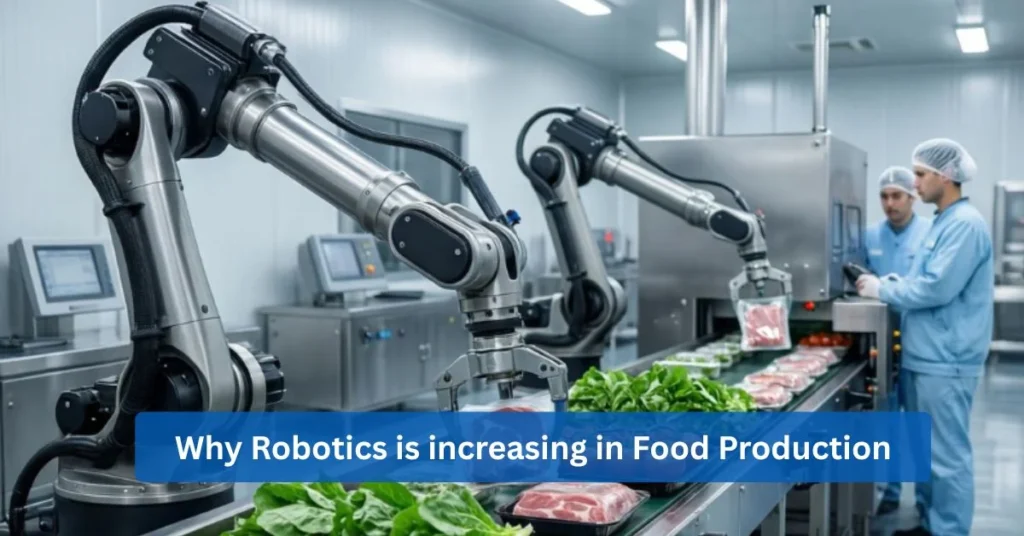
How Robotics in Food Processing Is Transforming Industry
Today’s global food industry is experiencing more pressure than ever. Manufacturers are now forced to rethink previous practices and processes as labor costs rise, safety regulations are stricter, and consistent quality is increasingly demanded.
This is where robotics in food processing comes in handy. Automation in food manufacturing is more demanded as it transforms how products are prepared, processed, and delivered. Combining new technologies and systems such as Industry 4.0, HACCP, AI, computer vision, and IoT transform operations for food manufacturers.
This article delves on the benefits of robotics in food factories and digital transformation in food processing. It explores what the future holds for smart food production.
What is Robotics in Food Processing?
Robotics in food processing include the use of automated machines to finish tasks compared to previous practices that use human labor. These tasks such as handling, cutting, sorting, packaging, and inspecting food products are done with the help of machines.
Unlike basic automation, modern food industry robotics make use of AI, computer vision, and IoT. With these, decisions are made smarter, more adaptable, and with real-time monitoring across production lines.
Scope of Robotics in Food Manufacturing
Almost all processes included in food production are now using robotic systems – from raw ingredients handling to warehouse automation.
Common applications are:
- Processing and preparation
- Quality inspection
- Packaging and palletizing
- Cleaning and sanitation
- Logistics and material transport
With this shift, we can see a broader digital transformation in food processing, aligned with Industry 4.0 principles.
Why Robotics is increasing in Food Production
Common problems that food manufacturers face are labor shortages and high employee turnover. Manual tasks are repetitive, physically demanding, and involve a higher risk of inconsistency.
With Robotics, these problems are given solution by delivering:
- Higher efficiency
- Improved hygiene
- Consistent output
- Lower long-term costs
Today’s consumers expect more from food manufacturers, thus automation in food manufacturing becomes necessary rather than just a simple upgrade that is optional.
From Manual Operations to Automated Systems
Past practices of food processing heavily relies on human skill and manual inspection. These practices may be flexible, however, scalability and consistency may be compromised.
Reduced variability is introduced by food factories that automate operations with the use of robotic arms, smart sensors, and interconnected software platforms. They are able to maintain speed and precision to ensure quality outputs.
The transition towards automations from traditional systems may be slow and many manufacturers are introducing hybrid systems to integrate robotics with human supervision.
How Food Processing Benefit From Robotics
Core advantages that food processing may expect from using robotics include:
- Faster production cycles
- Reduced contamination risks
- Improved product consistency
- Better resource utilization
These advantages also support compliance, profitability, and long-term sustainability.
How Do Robots Work in Food Processing Plants?
Robotic systems are part of an integrated workflow when used in food processing. They are in constant communication with machines, conveyors, and control systems to ensure performing precise actions.
Minimal deviation is ensured as each robot is programmed to execute tasks repeatedly.
Core Components of Robotic Systems
Robots in most food processing include:
- Robotic arms and mobile platforms
- Sensors and vision systems
- End-of-arm tooling (EOAT)
- Control software and SCADA systems
These components as a whole enable reliable and automated workflows
Sensors, Vision Systems, and Programming
Sensors come in handy for robots to easily detect position, temperature, weight, and movement. Vision systems on the other hand enable identification of size, color, shape, and defects.
To ensure that robots can easily respond to a change in product without the need for manual reprogramming, AI-motivated algorithms are employed. This flexibility is significant in terms of food production.
Integration with Production Lines
Robots are meticulously designed in a way that it can easily interoperate with conveyors, fillers, ovens, and packaging machines.
Robots designed for the food production industry commonly operate with AGVs (Automated Guided Vehicles) and warehouses to enable optimization of the flow of materials.
The Typical Robotic Food Processing Workflow
- Raw ingredients arrive via conveyor
- Robots perform sorting and inspection
- Cutting or portioning robots process items
- Packaging robots seal and label products
- Palletizers prepare goods for distribution
Real-time monitoring is incorporated in every step to attain performance and quality.
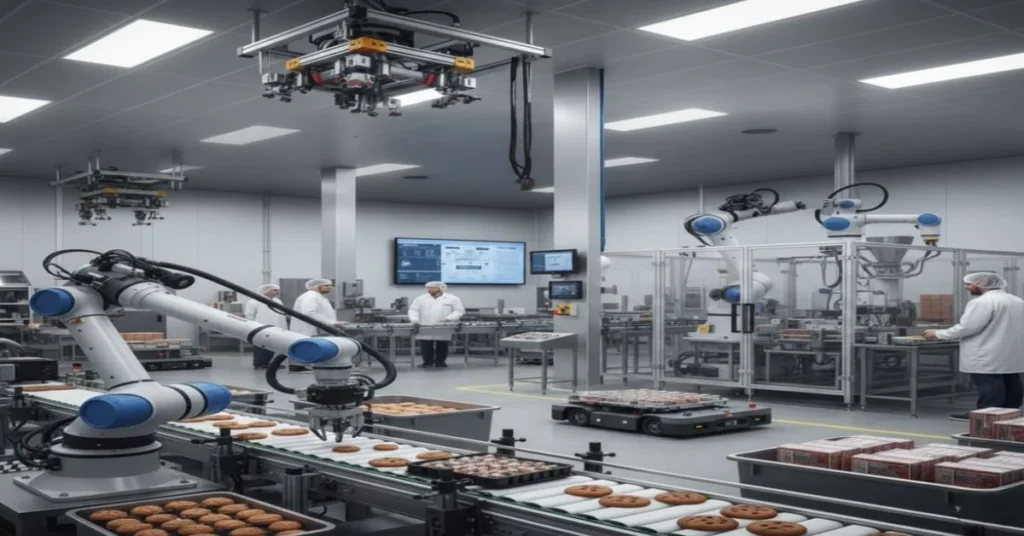
The Typical Robotic Food Processing Workflow
Different tasks call for different robotic solutions. Food manufacturers consider the speed, payload, hygiene requirements, and flexibility when choosing robots.
Pick-and-Place Robots
These robots are useful for repetitive transfer tasks. They are commonly used for:
- Sorting
- Loading
- Packaging
These are robots that operate at high speed and high accuracy.
Collaborative Robots (Cobots)
Cobots are carefully designed to work safely alongside humans. They are most ideal for:
- Small-batch production
- Flexible operations
- Manual-assisted processes
Cobots allow humans to still be in control while reducing possible fatigue.
Packaging and Palletizing Robots
These robots mostly handle sealing, labeling, and food packaging boxes. Palletizing Robots stack finished goods efficiently while ensuring consistency. These systems improve output while minimizing errors in handling.
Sorting and Grading Robots
Sorting robots assess quality attributes with the use of vision systems. They ensure that only products that are compliant move forward throughout the process. These robots are significantly valuable for produce, meat, and baked goods.
Automated Guided Vehicles (AGVs)
AGVs assist in transportation of materials within processing areas. They make the logistic movement in facilities more efficient and less congested. GVs create smarter processes in food production by maintaining a continuous workflow.
Where Are Robots Most Commonly Used in Food Processing?
Cooking and Preparation
Robots have become useful in mixing, cooking, and dispensing ingredients. They help in ensuring precise measurements and consistent results. Consistency in cooking and preparation affects final product quality.
Processing Tasks
The system of cutting, slicing, and peeling is made better with the help of robots as they enhance the speed and precision. They are highly applied in the processing of meat, poultry, and vegetables.
Here, automation minimizes waste and maximizes yield.
How Do Robotics Improve Food Safety and Hygiene?
In processing environments, food safety is among their top priority. Food safety robotics have enhanced food processing conditions and eased the process of prioritizing food safety.
Reduced Human Contamination
By using robots, handling can be limited and this also reduces the threat of contamination by a great margin. Minimizing human contact is needed to facilitate HACCP compliance.
Hygienic Design for Wash-Down Environments
Food-grade robots commonly use stainless steel and sealed joints. These robots are carefully designed to withstand high-pressure wash-downs, making them suitable for high-hygiene zones.
Sterilization and Sanitation Features
Built-in sterilization mechanisms can be included in some robotic systems. Safety is also improved by using UV light and automated cleaning cycles. All these make it possible to do operations around-the-clock.
Compliance with Food Safety Standards
Processes that are necessary according to the HACCP and other regulations are made more standard with the assistance of robotics. Automated documentation is also helpful to improve traceability. This minimizes compliance risk and potential audit risk.
Can Robotics Reduce Labor Costs and Improve Efficiency?
Labor challenges are still one of the biggest pain points in food manufacturing. Robotics and automation can address these challenges.
Labor Challenges in Food Industry
With human workforce, production schedules may be affected due to high turnover and absenteeism. Training a new workforce also adds on costs. Thus, robotics can help in offering stability in workforce planning.
Cost Savings from Automation
Long-term savings are still important, and robotics is a smart investment as they operate continuously without fatigue. ROI calculators show how robotics can provide payback within a few years.
Faster Production with Fewer Errors
Manufacturers can witness maintained speed and accuracy throughout shifts with robots. Errors drop significantly with the use of robots, compared to sticking with manual processes. This results in a reduction in wastes and reworks.
Role of Robotics vs Human Workforce
Even though robots are useful in making working environments more efficient, they do not completely replace human labor. They instead displace human beings in order to be transferred to supervisory, technical, and quality-oriented jobs. Robots do not eradicate human labor, but support workforce optimization.
How Are AI and Computer Vision Changing Food Quality Control?
AI-powered inspection systems are redefining quality assurance.
Detecting Defects and Contamination
Computer vision identifies foreign objects, discoloration, and shape anomalies. AI improves accuracy over time. This enhances defect detection automation.
Real-time Inspection
AI systems examine items on the line. Problems are immediately indicated and this allows minimization of losses downstream.
Consistency and Accuracy Improvements
With Artificial Intelligence, there is no need for subjective judgments based on inspection processes. Thus, every product is evaluated against the same standards. This helps in ensuring consistency that enhances customer satisfaction.
Predictive Quality Analytics
Machine learning is proactive – it predicts quality issues before they actually happen. Consequently, data insights also enable adjustments that are proactive, supporting smart food production strategies.
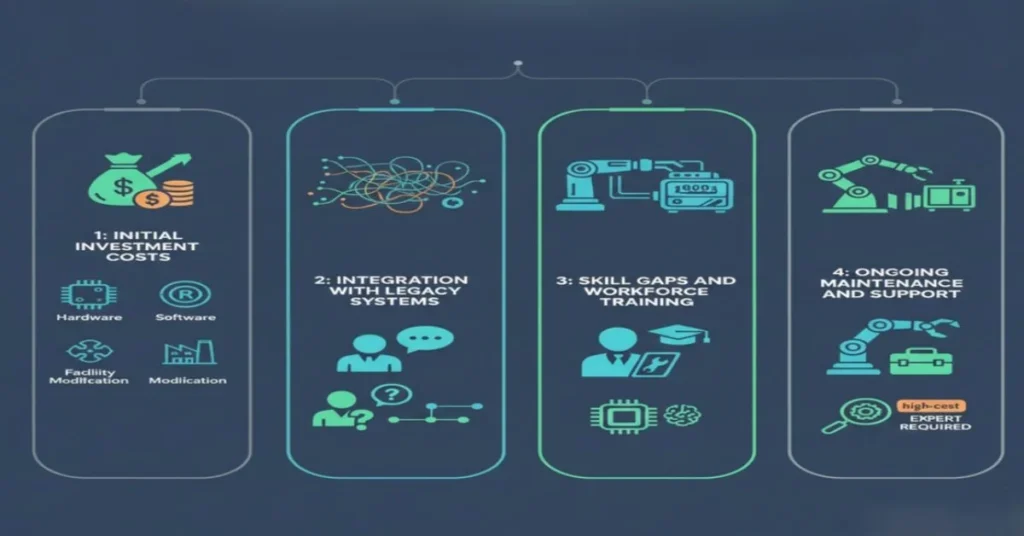
What Challenges Do Companies Face When Implementing Robotics?
Adoption of new systems such as robotics also comes with challenges.
Initial Investment Costs
These robotic systems require a significant capital to invest on them. Thus, hesitation from smaller manufacturers is common since they may face budget constraints when considering implementing robotic systems.
Integration with Legacy Systems
There is a possibility that old plants need retrofitting. The delay of deployment can occur due to the complexity of integration. However, experienced integration partners may minimize that risk.
Skill Gaps and Workforce Training
Technical skills are required in robotics. Long-term success is impossible without necessary training programs. Upskilling employees enhances the results of adoption.
Ongoing Maintenance and Support
Robots should be serviced regularly. Planning downtime is very important. To minimize disruptions, predictive maintenance tools come in handy.
What Are the Future Trends of Robotics in Food Processing?
Food automation is becoming smarter and more connected.
AI-Driven Predictive Automation
AI will optimize production in real time. Systems will adjust automatically to demand and quality signals. This increases agility and efficiency.
Fully Automated Production Lines
End-to-end automation is becoming achievable. Human intervention will focus on oversight and innovation. Smart factories will dominate large-scale production.
Robotics, IoT, and Data Analytics
A device that’s connected creates meaningful actions. IoT provides real-time tracking of plants. Decisions that are based on data will create competitive advantage.
Sustainability and Reduced Waste
Robotics decreases over-production and waste of materials. Accurate processing allows sustainability to foster during productions. This is in line with regulatory and consumer expectations.
Conclusion
Robotics for food processing provide the definitive advantages of efficiency, safety, and quality. It tackles possible issues on labor along with compliance and scalability.
To achieve successful adoption, there must be proper planning, ROI evaluation, and the right automation partners. For food manufacturers to stay competitive in their field, investing in robotics is no longer optional – it is strategic.
FAQs About Robotics in Food Processing
What is robotics in food processing?
These systems use automated machines to handle, process, and inspect food with high precision. They are specifically built to meet strict hygiene standards while maintaining high-speed production.
How are robots used in food manufacturing?
Robots perform tasks like precision cutting, high-speed sorting, and automated packaging. They also manage heavy palletizing and use advanced sensors for real-time quality control.
Why is automation important in the food industry?
It boosts productivity and ensures uniform quality across every single batch of food. Automation also reduces human error and stabilizes production during labor shortages.
Are collaborative robots (cobots) safe to use in food processing?
Yes, cobots have built-in sensors that stop them instantly if they touch a human worker. This allows them to work side-by-side with staff without the need for safety cages.
Can robotics help improve food safety?
Yes, by reducing human contact, robots significantly lower the risk of contamination. Their specialized “washdown” designs also allow them to withstand harsh chemical cleaning.
Are robots expensive to install in food processing plants?
Initial costs are high, but the long-term ROI is justified through increased efficiency and reduced waste. Most facilities recover the investment quickly through higher throughput and lower operational costs.
What types of robots are most common in food processing?
The most common types are pick-and-place robots, heavy-duty palletizers, and flexible cobots. Sorting robots and AGVs are also widely used for grading and internal logistics.
Do robots replace workers in the food industry?
No, they shift employees from repetitive physical labor to higher-value roles like machine oversight. This transition creates a safer workplace and a more technically skilled workforce.
How does AI help with food quality inspection?
AI vision systems detect tiny defects and contaminants much faster than the human eye. They provide proactive data that prevents waste and ensures only perfect products are shipped.
What is the future of robotics in food processing?
The future features fully data-connected “smart factories” that operate with near-zero waste. Robots will become even more adaptable, using soft-touch technology to handle delicate, organic shapes.