
How VR Training Prepares U.S. Troops for Combat
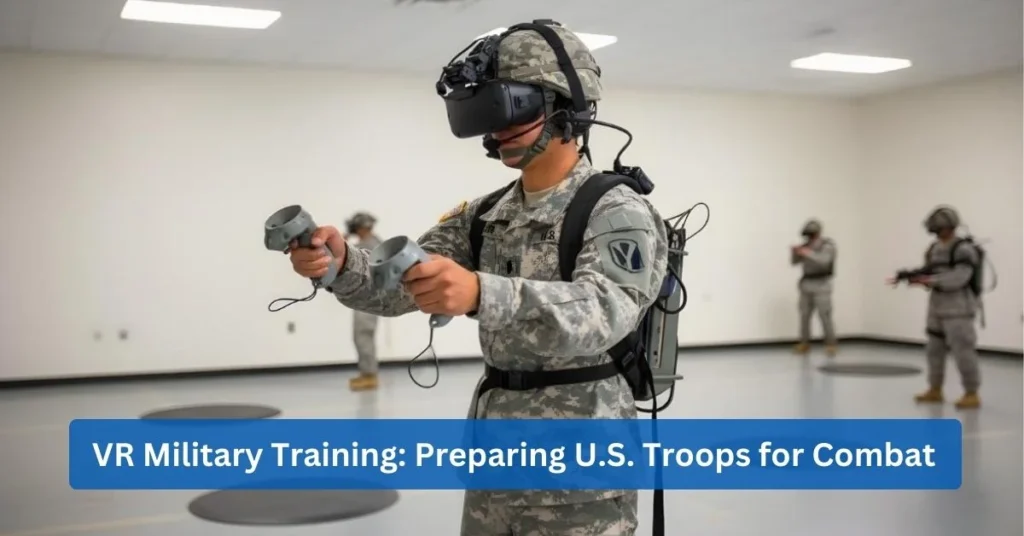
VR military training is transforming the way modern forces prepare for combat, whether through flight stimulators or full battlefield simulations. Today, the Army, Air Force, Navy, and Marine Corps rely on U.S. military VR training to recreate high-risk situations, such as live combat engagements, medical emergencies, and tactical operations inside immersive virtual environments. These simulations allow service members to train repeatedly, adapt to changing conditions, and build muscle memory without the dangers or costs of real-world exercises.
As virtual reality becomes more advanced, its role in military preparation continues to expand. By placing troops in realistic, high-pressure scenarious before deployment, VR is helping the U.S. military improve readiness, sharpen decision-making, and stay flexible in an increasingly unpredictable combat landscape.
What Is VR Military Training?
At its core, military VR training prepares service members for real-world missions without real-world risk. Instead of relying only on physical drills or classroom instruction, the military uses immersive military simulation to place trainees inside realistic, interactive combat scenarios. These experiences replicate the pressure, complexity of modern warfare while remaining flexible enough to adapt to evolving tactics and threats.
Definition of Military VR Training
Military VR training is a form of immersive simulation-based defense training that uses virtual reality to recreate combat, operational, and support scenarios. Troops train inside virtual battlefield environments where they can practice decision-making, coordination, and technical skills in a controlled setting. Unlike traditional simulators, VR fully immerses users, and unlike augmented reality, ot operates digital elements onto the real world.
The Mechanism of Military Training VR Systems
Military VR systems rely on several core technologies. The VR headsets are 360-degree, and the motion tracking device provides the trainee with the ability to move and interact naturally. AI-simulation helps generate different kinds of battlefields and different enemy behaviors to provide a “true-to-life experience” feature. Together, these technologies make military VR training flexible, repeatable, and mission ready.
Does the Military Use VR for Training?
Virtual reality is no longer just a tech experiment; it’s a key part of how the U.S. military prepares its forces. Supported by the U.S. Department of Defense, research programs like DARPA, and strategic oversight from the Pentagon, VR lets service members train in realistic, high-pressure scenarios without real-world risk.
U.S. Army VR Training Programs
The U.S. Army is a significant user of VR, with its Synthetic Training Environment (STE), a conglomerate platform aimed at facilitating large-scale, immersive military simulation. Soldiers can practice squad maneuvers, high-intensity combat, and mission coordination repeatedly in a controllable and adaptable space. Such artificial training environments can be updated anytime, and this flexibility allows the units to practice changing threat scenarios.
U.S. Air Force VR Flight Simulation
Air Force pilots use VR for cockpit simulation training and mission rehearsal. These cabs enable pilots to train on flight tasks, emergency reactions, and warfare in high-fidelity settings, letting pilots sharpen skills safely and efficiently while reducing costs.
Navy & Marine Corps VR Programs
VR is applied in the Navy and Marine Corps to simulate ship bridges and close-quarters combat (CQC). These programs are also compatible with the joint standards that are common to the allied forces, such as NATO, to be used to facilitate interoperability and mission readiness.
Types of VR Military Training Systems
The US military uses numerous VR systems to train soldiers to fight in the contemporary world. These systems offer soldiers simulated military training, which allows them to train under highly stressful scenarios without risking their lives.
- Combat & Urban Warfare Simulation: The soldiers are subjected to stiff battles and urban warfare within virtual battlefields. They train for coordination of the squads, room clearing, and making tactical decisions in a safe and consistent manner.
- Flight & Aviation Training: VR cockpit simulation mimics flight conditions, accidents, and battles. It provides realistic flights that help pilots prepare for missions.
- Medical & Battlefield Trauma Training: Medics and soldiers train to prepare for battlefield injuries, triage, and emergency response. VR creates synthetic training environments and emergency scenarios to help soldiers build critical skills under stress.
- Vehicle & Convoy Simulation: Drivers and crews rehearse operations in tanks, armored vehicles, and convoys. VR simulates ambush and road conditions to generate various experiences.
- Special Operations & Tactical Drills: VR is also highly effective in preparing for high-risk missions. These systems offer dynamic simulation in adapting to threats and experiencing various environments.
These VR systems enable the military to train smarter and more efficiently. Soldiers acquire experience, confidence, and preparedness while preventing actual risks.
Advantages of VR Military Training
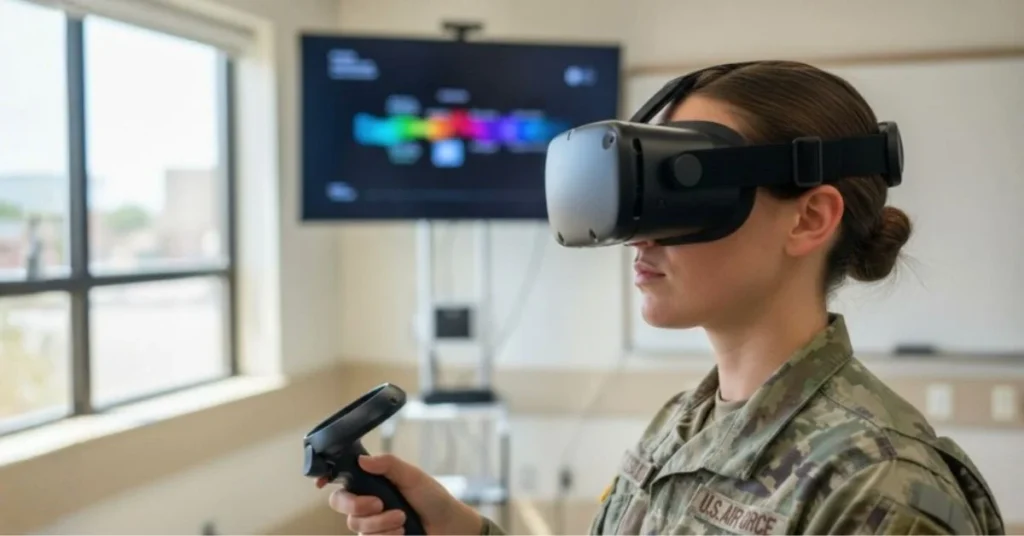
VR military training is transforming how the United States military prepares its forces. It combines realistic scenarios with safety, letting soldiers build skills and confidence without real-world risk.
- Cost-Effective Military Training:Military training VR reduces expenses from live exercises, equipment wear, and travel. Virtual environments allow troops to practice repeatedly while keeping budgets under control.
- Reduced Risk & Safer Simulation: Immersive military simulation recreates high-risk combat and urban operations safely. VR battlefield simulation lets soldiers experience challenging situations and intense scenarios without danger.
- Improved Combat Readiness: Virtual reality combat training strengthens decision-making, coordination, and situational awareness. Structured exercises help troops gain confidence and prepare for real missions.
- Real-Time Performance Analytics: Tactical VR training systems track actions and deliver immediate feedback. The strengths, weaknesses, and areas of improvement can be identified effectively.
- Scalable Training Across Locations: Mixed reality military training connects units across different bases. Troops can train together in shared virtual environments, improving teamwork, interoperability, and joint operations readiness.
By combining military simulation technology with combat readiness training, VR prepares soldiers smarter, faster, and safer than ever. These systems make training adaptable, measurable, and highly effective.
VR vs Traditional Military Training
The process of military training is changing fast, and VR has become essential for quality and advanced military training. Although live exercises, drills, and fieldwork continue to be a vital part of the training, VR military training provides a new dimension of training troops on complex scenarios without subjecting them to risk.
Advantages of VR Training
VR enables the military personnel to be transported into full-scale military simulators that recreate the conditions of the battlefield, urban, or tactical scenarios. The trainees are able to rehearse various missions, develop muscle memory, and enhance strategic planning.
Systems also offer real-time performance metrics, allowing instructors to know the strong and weak areas of the troops. VR is affordable, can be replicated at different places, and can replace risky activities.
Limitations of VR Systems
VR still cannot substitute the physical and psychological requirements of real-world training because of its limitations. Tactile feedback, environmental uncertainty, and working under pressure are rather challenging to completely reproduce in a virtual setting.
Can VR Replace Physical Training?
VR is not a substitute for physical activity; rather, it supplements it. It improves situational awareness, rehearses strategies, and adapts to dynamic situations, which improves preparation. Nevertheless, live exercises, field training, and practical training are essential in the development of endurance, resilience, and practical combat skills.
When military training through virtual reality is incorporated with the traditional training, the military can attain a balanced approach, flexible as well as highly effective. VR enhances the possibilities of learning while maintaining the safety of soldiers.
Technologies Powering Military VR Training
Modern VR military training relies on combined advanced technologies that work together to create realistic, adaptable, and scalable training experiences. These tools turn virtual scenarios into practical learning environments that closely reflect real-world operations. The main technologies of the military VR training and immersive learning are the following:
Artificial Intelligence in Defense Simulation
Artificial intelligence plays a central role in defense simulation by driving dynamic, responsive scenarios. AI controls opposing forces, civilian behavior, and environmental conditions, allowing simulations to react in real time to trainee actions. This makes training sessions unpredictable and contributes to the enhancement of tactical judgment and situational awareness under pressure.
Haptic Feedback & Motion Capture
VR training is further enhanced with haptic feedback and motion capture. Motion tracking is used to record natural body motion, while haptic systems are used to mimic normal sensations such as recoil, impact, or resistance. These systems reinforce muscle memory and make immersive military simulation feel more realistic and engaging.
Extended Reality (XR) in Military Training
Extended reality combines virtual, augmented, and mixed reality to increase training flexibility. XR enables instructors to integrate both online and physical space to serve both in-the-classroom experiences and sophisticated mission training in simulated settings.
Cloud-Based & Multi-User Simulation Platforms
Cloud-based platforms enable multiple units to train together across different locations. Shared virtual environments support coordination, communication, and joint operations while reducing travel, cost, and logistical constraints.
Military Training VR News & Recent Developments
Military VR training is still developing rapidly, and new investments, alliances, and international implementation are promising long-term interest in immersive defense technologies. Recent developments show how virtual training is moving from experimentation into standard military practice.
Recent U.S. Military VR Investments
The U.S. military has put additional funds into VR-based training programs focused on combat readiness, mission rehearsal, and force protection. Such investments underline scalable systems that facilitate the process of data-driven assessment and repeated skill building in a variety of units.
Defense Tech Partnerships
Companies that provide VR, AI, and XR technologies are actively collaborating with defense organizations in order to hasten innovation. These partnerships revolve around realistic experience, multi-user coordination, and real-time performance analytics to make military training VR systems develop more rapidly.
Global Military Adoption
Countries all over the world are implementing VR and XR training technology. The United Kingdom is executing AI-powered XR applications with its Ministry of Defense to speed up training in multi-domain workforces. Although there are recent announcements concerning China and Israel, the global defense markets are also putting more resources into the simulation and immersive training solutions as part of the larger modernization process.
Challenges of VR in Military Training
As much as VR has been a boost to the current training in the defense, there are certain challenges associated with it that need to be handled keenly by the military planners to guarantee it is effective in the long term.
- Cybersecurity Risks: The VR systems in the military are based on networked and data-filled simulations. Without adequate protection, sensitive training data may be at risk from cyber threats, particularly when tactical or operational conduct is involved in simulations.
- Hardware Limitations: Motion tracking, computing power, and high-performance headsets can be very expensive and resource heavy. Prolonged training may also be restricted by comfort, battery life, and system life.
- Simulation Realism: Despite the high level of visual immersion VR provides, it is difficult to recreate the stress of the real world. The variability of the environment and physical feedback remains a challenge, which cannot guarantee a 100% relevance with real combat.
- Motion Sickness: Some trainees experience simulator sickness, including nausea or disorientation, such as losing their orientation, which may end up shortening training days and efficiency.
- Budget Allocation: Balancing investment between VR systems and traditional training requires careful planning to ensure readiness without overspending.
The Future of VR Military Training
The future of VR military training is devoted to smarter and more adaptive military training. AI-driven combat simulations will adjust scenarios in real time based on trainee performance and behavior. Metaverse-style training environments will allow persistent, shared virtual spaces for large-scale coordination.
Fully immersive synthetic battlefields will increase realism, while LVC (Live, Virtual, Constructive) integration will seamlessly connect real-world exercises with virtual and simulated forces for more effective, flexible training.
Conclusion
Through VR military training, the U. S military is transforming the way its troops get ready to fight in contemporary war. Such immersive systems not only contribute to being better prepared and skilled tactically today but also indicate a future in which AI-driven and metaverse-style, totally integrated simulations will only become increasingly more significant.
As virtual reality continues to evolve, military training will become more adaptive, scalable, and realistic, providing service members with unprecedented opportunities to develop expertise safely and efficiently. Through a combination of the best defense research programs and strategic management, VR military training is taking root, ensuring that forces remain mission-ready, resilient, and ahead of emerging threats.
Frequently Asked Questions (FAQ)
Does the military use VR for training?
Yes, the U.S. military does utilize VR to train soldiers for combat, flight, and tactical scenarios in all four arms: Army, Air Force, Navy, and Marine Corps.
How realistic is VR military training?
VR military training provides highly immersive simulated experiences that include AI-generated conditions, haptic response, and motion tracking, but it does not have the ability to simulate the physical stress of real-life combat.
What VR headsets does the military use?
The military employs advanced VR headsets from companies like Varjo and other defense-grade XR devices designed for high-resolution, multi-sensory simulations.
Is VR training cost-effective for the military?
Yes, VR saves money on live training, equipment wear, and transportation, while enabling repeated training in virtual environments.
Which branch of the military uses VR the most?
The U.S. Army uses its Synthetic Training Environment to conduct large-scale combat and tactical simulations.