
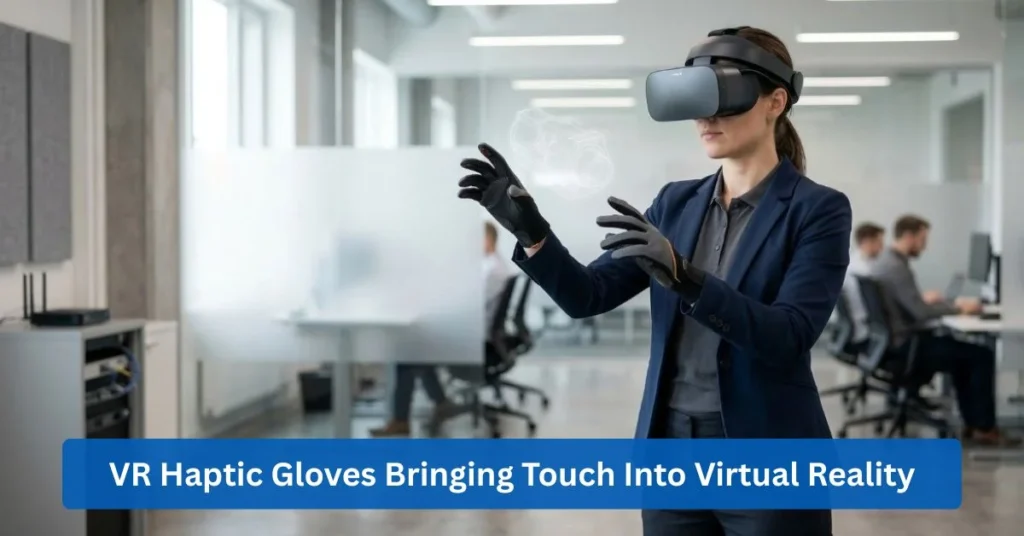
VR Haptic Gloves Bringing Touch Into Virtual Reality
Virtual reality has already revolutionized the manner in which organizations train employees, simulate complex environments, and design products. Nevertheless, there has never been a bigger weakness: the lack of touch. Whereas graphics and sound are effective simulators of environments, the lack of tactile experience with the objects usually makes them less real. That is where VR Haptic Gloves alter the situation.
Commercial VR haptic gloves are becoming more popular in enterprises to increase the experience of immersive virtual reality training, simulation systems, and engineering design. In the healthcare sector, defense, and manufacturing, organizations are learning about the value of advanced VR touch gloves in transforming the learning process and readiness to operate.
Companies that are considering enterprise VR haptic gloves can rely on solutions that the company, such as Augmum Inc., has designed as effective in providing a connection between the virtual and real worlds. These devices allow trainees to interact with virtual tools, equipment, and environments using natural hand movements, something traditional VR controllers cannot replicate.
As the extended reality gloves keep evolving, they will be the main elements of the XR training systems and the future of simulation. This article will explain the functionality of XR gloves, the advantages, and the business ways of utilizing them to achieve a more immersive and more effective training environment.
What Are Haptic Gloves and How Do They Work?
VR haptic gloves are wearable devices designed to stimulate the sense of touch within virtual environments. Rather than operating handheld controllers, users don wearable gloves, which have sensors and feedback to enable them to touch and interact with computer-generated objects in a natural way.
These gloves track hand movements and deliver tactile feedback, which allows users to experience physical sensations while interacting with virtual objects.
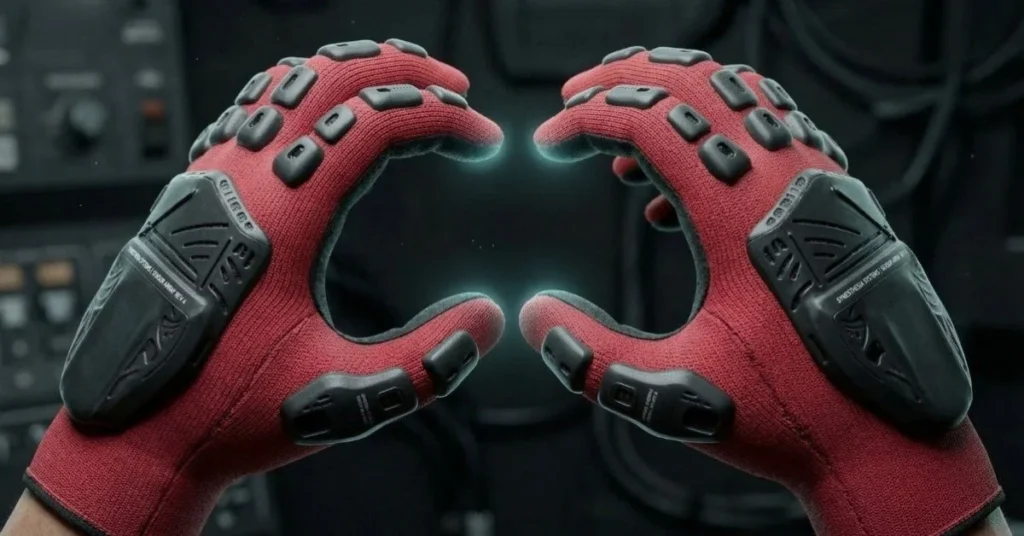
Understanding Force Feedback Technology
One of the most important features of VR gloves with force feedback is their ability to simulate resistance and pressure.
In force feedback technology, actuators, motors, or mechanical resistance systems are built into the glove to simulate forces of the real world. The glove is able to provide resistance to the fingers when the user picks up a virtual object so that the object appears to have weight or hardness.
For example:
- Picking up a virtual tool can feel more resistant and heavier.
- Tactile resistance may be created by pushing a button.
- Grip pressure can be modeled by holding equipment.
Such tactile feedback in VR would enhance a lot of realism in simulations and training exercises.
Tactile Feedback in Virtual Environments
Besides force feedback, several haptic feedback gloves for VR have tactile feedback features, simulating small body parts like vibration or texture.
These are sensations that are produced with the help of small haptic actuators placed on the fingers and palm regions of the glove.
Users can experience:
- Surface textures
- Impact sensations
- Button clicks
- Contact feedback
This detail enables users to experience interactions in digital environments as though they were real.
Motion Tracking and Hand Presence in VR
The high-quality motion tracking is another fundamental characteristic of professional VR gloves with haptics.
The gloves have numerous sensors that monitor finger movement, hand orientation, and gesture patterns. This data is translated in real time into the virtual environment, which is why the user can see their hands and interact in a natural manner.
Key technologies include:
- Finger tracking sensors
- Hand tracking VR devices
- Motion capture systems
- Gesture recognition on AI
These technologies provide a great feeling of hand presence, which is vital to effective training simulation.
The Difference Between Basic VR Controllers and Haptic Feedback Gloves
The old type of VR controllers has a low level of vibration feedback and interaction.
Nonetheless, advanced VR touch gloves offer several advantages:
Feature | VR Controllers | VR Haptic Gloves |
Hand tracking | Limited | Full finger tracking |
Interaction realism | Moderate | Highly immersive |
Touch simulation | Basic vibration | Tactile + force feedback |
Training effectiveness | Moderate | High |
In the enterprise case, the best VR haptic gloves for an enterprise environment provide a much more realistic and entertaining experience.
Key Features of Advanced Haptic Gloves for Simulation
Modern enterprise VR haptic gloves combine advanced hardware and software to create natural interaction systems for professional environments.
Precision Finger Tracking and Gesture Recognition
Advanced motion tracking gloves record very accurate movements of the fingers.
This enables:
- Accurate hand positioning
- Gesture-based controls
- Manipulation of natural objects
The high accuracy of tracking has particular relevance to training settings where the accuracy of hand movements is directly related to the learning outcomes.
To illustrate, engineers who are involved in the maintenance of equipment have to do certain gestures in a proper manner to finish the job.
Realistic Force Feedback and Resistance Simulation
High-end VR gloves with force feedback simulate resistance during object interaction.
Users can feel:
- Weight of virtual tools
- Difficulty in drawing levers.
- Pressure associated with object holding.
These haptic interactions render haptic gloves for simulation training a perfect fit for a training environment that is highly sensitive to physical realism.
Wireless Connectivity and Wearable VR Design
Modern professional VR gloves with haptics are supposed to be lightweight, comfortable, and wireless.
The major design enhancements are:
- Ergonomic glove materials
- Lightweight sensors
- Communication systems on a wireless basis.
- Long battery life
This allows trainees to use the VR gloves comfortably during extended training sessions.
Integration With Industrial and Enterprise VR Systems
One more valuable aspect of commercial VR haptic gloves is that these gloves are compatible with enterprise XR software platforms.
New haptic gloves can be integrated with XR training systems and VR simulation systems. They can also be used to work with engineering design software and digital twins to enable professionals to engage with digital models and simulations using natural hand movements.
Such companies as Augmum can be oriented to developing an integrated XR ecosystem with extended reality gloves in combination with immersive training simulations.
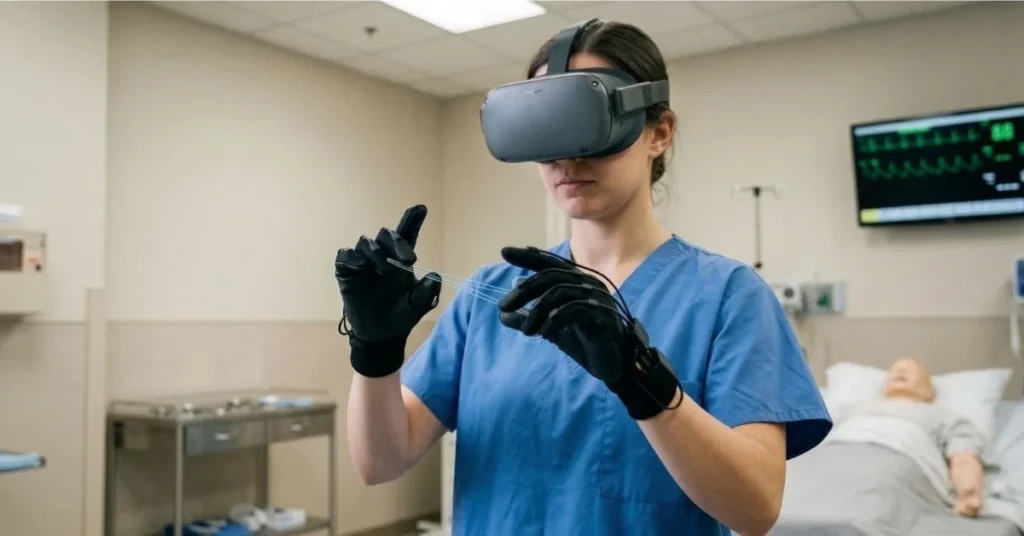
Applications of Haptic Gloves for Training and Simulation
The use of VR haptic gloves for the training process is growing in various sectors because organizations have realized the importance of touch-based virtual learning.
Industrial VR Training Solutions
The industrial setting also demands that workers use sophisticated machinery and equipment in a safe way. It is now possible to train employees in simulated environments, then subsequently learn how to operate real machines because of haptic feedback gloves for VR.
Manufacturing and Equipment Handling
The manufacturing environment requires employees to be taught the use of tools, how to put parts together, and how to operate machinery.
Using haptic gloves for simulation, trainees can:
- Assembling equipment during practice
- Handle virtual tools
- model maintenance processes
Such workouts create muscle memory and enhance job preparedness.
Safety and Hazard Response Training
Safety training is one of the most powerful applications of VR haptic gloves for training.
Employees will be able to train their reactions to equipment failures, accidents with chemicals, and fire incidents, and the workers will learn to practice the most important safety skills, but they will not be put in a dangerous situation.
Medical VR Simulation Tools
Healthcare training is another field where advanced VR touch gloves are becoming increasingly valuable.
Surgical Skill Development
Professional VR gloves with haptic feedback can be used by medical students to practice surgery in a simulated setting.
The gloves simulate:
- tissue resistance
- tool pressure
- surgical accuracy movements
This offers practical experience without endangering the real patients.
Patient Interaction Practice
Patient examination may also be simulated in VR.
The medical trainees are able to practice:
- palpation techniques
- physical examinations
- instrument handling
The effect of touch feedback is enhanced realism and skill acquisition
Military and Defense Simulation
Realistic training simulations are important to defense organizations.
Enterprise VR haptic gloves enable soldiers to train in simulated digital environments and work with virtual equipment.
Tactical Scenario Training
Soldiers will be able to simulate combat conditions, the handling of equipment, and scenarios of the mission.
Touch-enabled VR improves:
- situational awareness
- reaction time
- operational readiness
Equipment Operation Simulation
VR gloves with force feedback allow the military trainees to train operating complex machinery, vehicles, or weapons systems.
This minimizes the wear and tear of costly equipment.
Engineering and Product Design Prototyping
XR training systems and virtual prototyping tools are used more and more by design teams.
Engineers are able to communicate with digital models with the help of extended reality gloves, even prior to the establishment of the physical prototypes.
Benefits include:
- faster product development
- improved design validation
- reduced prototyping costs
Benefits of Using Haptic Feedback Gloves in Enterprise Environments
Enterprise VR haptic gloves allow the company to get important operational benefits.
Enhanced Immersive Virtual Reality Training
Touch feedback contributes to VR training to a greater extent of immersion.
The trainees get the illusion that they are actually playing with equipment and environments, which makes them more engaged and more realistic.
Improved Skill Retention Through Touch-Based Learning
Research indicates that practical learning is very effective in the retention of knowledge since the learners use more than one sense in the entire learning process. Studies have discovered that experience and practical forms of learning have a greater comprehension and memory recollection than passive learning.
Trainees are predisposed to memorize procedures and techniques when they can touch virtual objects using haptic feedback gloves for VR.
Reduced Training Costs and Operational Risks
Conventional training may entail:
- expensive equipment
- sports amenities
- instructor supervision
Using haptic gloves simulation offers companies the opportunity to do training in digital environments, which is more cost-effective and safer.
Real-Time Performance Feedback and Analytics
Most enterprise VR haptic gloves are connected to performance statistics through analytics.
Organizations can measure:
- task completion time
- movement accuracy
- procedural errors
This information can be useful in enhancing the training and performance of workers.
How to Choose the Best VR Gloves With Force Feedback
When choosing the appropriate VR haptic gloves, it is important to consider a number of technical and operational factors.
Evaluating Tracking Accuracy and Responsiveness
Motion tracking gloves are effective based on their ability to capture hand movements correctly.
Gloves that organizations seek should have:
- high-precision sensors
- low latency tracking
- Gesture recognition in real-time.
Realistic interactions are ensured through accurate tracking.
Compatibility With Simulation Platforms
The companies must ensure that the VR gloves with force feedback are compatible with their existing VR platforms and training software.
The acceptance of compatibility with XR training systems makes the implementation smooth.
Comfort, Ergonomics, and Durability
Gloves need to be comfortable due to the long time they are put on.
The best VR haptic gloves for enterprise should offer:
- breathable materials
- adjustable fit
- durable construction
These make it easier to use and last longer.
Scalability for Large-Scale Enterprise Deployment
Companies tend to implement VR training in more than one place. In the case of larger organizations, commercial VR haptic gloves have to be compatible with multi-user settings, support remote instruction, and be compatible with centralized management systems to provide scalable implementation.
Where to Buy Haptic Gloves for Commercial Use in the USA
To companies interested in purchasing VR haptic gloves in the United States, a good supplier would be the one that provides enterprise-level technology and scalability to maximize the benefits of immersive training and simulation.
Comparing Enterprise VR Hardware Providers
Not every provider provides an equal amount of hardware performance and enterprise support.
Companies should evaluate:
- tracking accuracy
- haptic realism
- integration capabilities
- Enterprise deployment models.
XR Solution XR Specialists, such as Augmum, offer complete VR training ecosystems to use in the enterprise.
Customization and Integration Support
Business applications usually have custom requirements.
Providers should offer:
- API integration
- custom simulation development
- enterprise XR consulting
Personalization makes the gloves compatible with the current work processes.
Pricing Considerations and ROI Analysis
Professional VR gloves with haptics may be as expensive as they are capable of being.
Organizations are to consider:
- hardware costs
- software integration fees
- maintenance requirements
Nevertheless, ROI in the long term usually justifies initial investment through cutting trainers as well as enhancing the performance of employees.
Requesting Demos and Product Trials
Companies are encouraged to demand pilots or product demonstrations before buying the advanced VR touch gloves.
The evaluation of the technology can be done by testing it to enable organizations to test:
- comfort and usability
- feedback realism
- Interoperability with training systems.
The Future of Haptic Technology in Extended Reality (XR)
The history of the development of VR haptic gloves is tightly connected with the overall development of extended reality technologies.
AI-Driven Adaptive Feedback Systems
The haptic systems in the future will have artificial intelligence that will be used to change the feedback dynamically depending on the actions of the user.
The AI-based systems might be able to predict more natural interactions and offer personalized training experiences.
Expansion Into the Metaverse and Remote Collaboration
With the development of digital collaboration platforms, metaverse interaction devices will be present in greater numbers.
Haptic gloves will enable distant teams to respond to common virtual worlds and cyber assets as though they were in a tangible state.
Advancements in Wearable VR Devices
The hardware will be enhanced, resulting in:
- lighter gloves
- more precise sensors
- improved wireless connectivity
These developments will ensure that the enterprise applications of the extended reality gloves will be more accessible.
The Role of Haptics in Next-Generation Simulation
The future will establish touch as a fundamental component of virtual reality simulation spaces. The combination of VR haptic gloves with their digital interfaces will enable industrial training and remote robotics control to achieve real-world experience.
Experience the impact of haptic technology on immersive experiences, which will shape future development for your business.
Learn more here: https://www.augmum.com/blog
FAQs
Are haptic gloves compatible with all VR headsets?
A majority of VR haptic gloves are compatible with most VR platforms, although this depends on software platforms and hardware. When deploying a headset and a platform, enterprises need to confirm their compatibility.
How accurate is force feedback in training simulations?
The current VR gloves with force feedback offer high levels of resistance and tactile feedback. Although the tactile experience is not the same as in reality, the technology has been developed to the point that it can be used to simulate professional training in most industries.
What industries benefit most from touch-enabled VR?
Hands-on VR is most effective in sectors that require a high level of skills, such as manufacturing, healthcare, military and defense, engineering, and aerospace. These sectors apply enterprise VR haptic gloves in training, simulation, and the development of products.
What is the average cost of enterprise haptic gloves?
Depending on the hardware features, integration needs, and training software, the commercial VR haptic gloves may cost thousands of dollars or more, enterprise-specific prices.