
Robotic Arm Guide: Types, Applications, Working Principle & Benefits
You might still think of these as something from a sci-fi movie, but they are actually the secret muscle behind everything from your car to your favorite gadgets. Essentially, a robotic arm is just a mechanical limb you can program to do exactly what a person’s arm does, but with way more power and zero fatigue.
If we’re looking for a simple robot arm definition, think of it as a highly programmable, mechanical limb designed to mimic a human arm. By weaving advanced robotic arm technology into their daily operations, businesses have completely transformed how they build, pack, and ship the products we use every day.
It is hard to overstate how much robotic arm automation matters right now. These aren’t just dumb machines; they are sophisticated, computer-directed tools built for pinpoint accuracy. In this guide, we are going to break down the robotic arm working principle, look at the main robotic arm components, and see how this tech is making the world run a bit smoother.
What is a Controlled Robotic Arm?
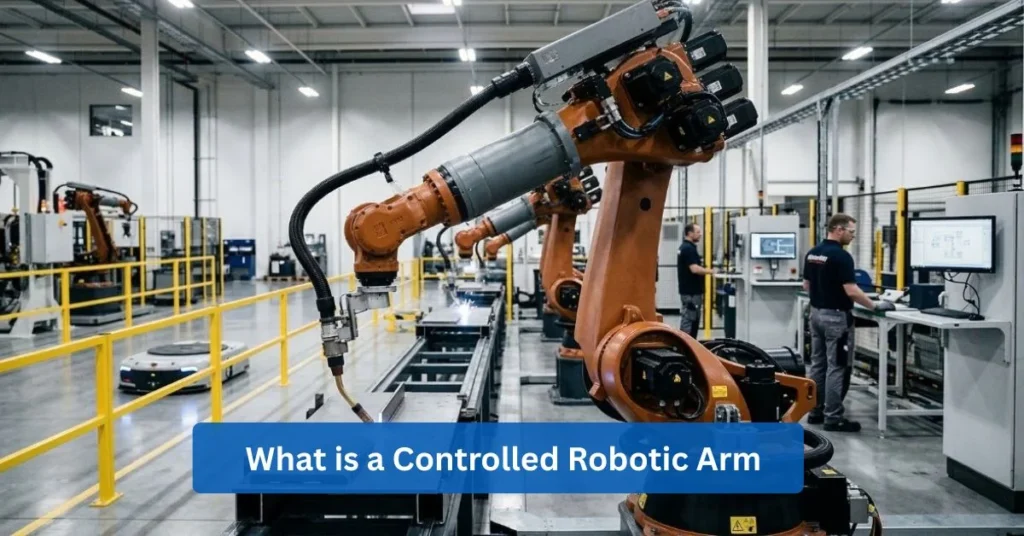
A controlled robotic arm is basically an automated mechanical appendage that takes orders from a computer to perform tasks. An industrial robotic arm lives inside an automated robotic arm system, relying on precise code and constant feedback. A controlled robotic arm uses complex software to tweak its movements spontaneously, ensuring accuracy every single time.
Components of a Controlled Robotic Arm
To really understand how these machines work, we need to look at the core robotic arm components.
- Sensors: the robotic arm sensors are like the eyes and brains of the machine. They scan the environment and monitor the internal position of the robotic arm joints.
- Actuators: they are the powerful motors that move the robotic arm joints. They provide the brute force needed to lift heavy payloads and swing the arm around.
- Controllers: the robotic arm controller is the brain of the setup. It takes the human-written robotic arm programming and pairs it with the live sensor feedback.
- End Effectors: The robotic arm end effector is whatever tool is attached to the end of the arm. This could be a standard robotic arm gripper for moving things around.
How Controlled Robotic Arms Work
If you want to know how robotic arms work, you have to look at the beautiful relationship between hardware and software.
- Control systems: A high-end robotic arm control system dictates the micro-movements of the machine.
- Programming methods: We use different robotic arm programming methods, like offline software simulations or teach pendants to input commands.
- Human-robot interaction: Thanks to the invention of the collaborative robotic arm, human-robot interaction is smoother than ever.
Main Components of a Robotic Arm
Let’s break down the physical robotic arm structure. It has 6 main robotic arm components, specifically:
- Base: This is usually bolted heavily into a floor, wall, or sturdy mobile platform. It has to be incredibly strong to handle the kinetic energy and swinging weight of an active industrial robotic arm.
- Shoulder Joint: This controls the primary vertical and horizontal sweeping motions. In a standard industrial robotic arm, this joint has the biggest, beefiest motor.
- Elbow Joint: These joints let the upper and lower sections of the arm bend, fold, and extend. The elbow is super important for adjusting the machine’s reach.
- Wrist: The wrist handles the fine-tuned, delicate movements at the end of the line. It’s usually made up of several smaller robotic arm joints that let the machine twist, tilt, and roll.
- End Effector (Gripper/Tool): A standard robotic arm gripper is great for grabbing things off a conveyor belt, but you can swap the end effector out for almost anything. It’s the ultimate multi-tool.
- Control System: The robotic arm control system is a vital component. It holds the power supplies, safety switches, and the actual computer brains that tell the physical robotic arm structure what to do.

Types of Robotic Arms
You’ll find a huge variety of industrial robot arm types out in the wild. Picking the right one isis important. Let’s look at the main contenders:
1. Cartesian Robotic Arm
- Structure: they look less like arms and more like giant 3D printer frames. They move along three straight lines (X, Y, and Z axes).
- Advantages: accurate, easy scale-up, and can carry incredibly heavy loads.
- Common applications: CNC machining, large-scale 3D printing, and moving heavy materials.
2. Cylindrical Robotic Arm
- Design: it has a spinning base joint and a linear arm joint.
- Working mechanism: the robotic arm working principle here is all about a cylindrical work envelope. It spins in a circle while reaching up and out.
- Industrial uses: you’ll see these doing assembly work, spot welding, and loading parts into other machines.
3. Spherical / Polar Robotic Arm
- Structure: these have twisting joints, a rotary joint, and a linear joint.
- Motion capability: Because they use a polar coordinate system, they are surprisingly good at reaching down into deep spaces.
- Applications: gas welding, metal casting, and heavy-duty forging.
4. SCARA Robotic Arm
- Selective Compliance Assembly Robot Arm: The SCARA robotic arm is the speed demon of the robotics world.
- Key features: a SCARA robotic arm is totally stiff when you push down on it (the Z-axis), but swings freely side-to-side (the X and Y axes).
- Industrial assembly usage: the SCARA robotic arm can be seen in pick-and-place manufacturing industries.
5. Articulated Robotic Arm
- Most common robotic arm type: When you picture a robot in a factory, you are picturing an articulated robotic arm.
- Degrees of freedom: a standard articulated robotic arm usually has between 4 and 6 axes.
- Manufacturing applications: It is the go-to robotic arm in manufacturing, doing everything from painting cars to complex arc welding.
6. Parallel Robotic Arm (Delta Robot)
- Structure: Delta robots have three delicate, synchronized arms connected to a single central plate.
- Speed advantages: arms that are feather-light and heavy motors at the base.
- Packaging and food industry use: perfect for sorting chocolates on a fast-moving belt, packing pills, or organizing light food items.
7. Collaborative Robotic Arm (Cobots)
- Human-robot collaboration: A collaborative robotic arm is built specifically to play nice with humans.
- Safety features: a collaborative robotic arm is packed with soft padding, force-limiting tech, and crazy-sensitive sensors.
- Small business applications: because they are safe and relatively easy to program, the collaborative robotic arm has finally brought automation to small startups.
Robotic Snake Arms: A Flexible and Advanced Robotic Arm Technology
What Are Robotic Snake Arms?
This is a highly specialized, hyper-flexible branch of robotic arm technology designed to slither into tight, hazardous, or complex spaces where a normal, rigid machine would just get stuck.
Key Features of Robotic Snake Arms
- Enhance Workforce Efficiency
- Can finish tasks faster and with fewer costs compared to human labor. They simplify operations and reduce the time and energy required.
- Boost Product Quality
- Ensures that goods are manufactured in the highest quality because of its degree of precision.
- Safer Workplace Environment
- Lessens risks, errors, high demand, or repetitiveness, and minimizes hazards and fatigue. It improves the workplace by ensuring safety and well-being.
- Extended Operation Efficiency
- It can operate 24/7. Compared to humans, robots do not require breaks, making them reliable in increased productivity.
How Robotic Snake Arms Differ from Traditional Robotic Arms
Classification | Robotic Snake Arms | Traditional Robotic Arms |
Movement | Follow a continuous path | Pivot from base |
Structure | Flexible backbone or multiple short segments | Rigid links with distinct joints |
Workspace | Excels even in complex spaces | Needs open space |
Payload | Low | High |
Control System | Complex multi-segment path planning | Standard kinematics |
Robotic Arm Types Based on Control Systems
How smart a machine is depends entirely on its robotic arm control system. Here’s how they operate:
- Manual Controlled Robotic Arms: These aren’t automated. A human operator drives them using joysticks or wearable exoskeletons. You see these in deep-sea submarines or when handling highly radioactive materials, where human judgment is needed.
- Computer Controlled Robotic Arms: This is your bread-and-butter robotic arm control system found in most factories. A programmer writes code, and the arm executes that exact motion loop flawlessly.
- AI-Powered Robotic Arms: With AI robotic arm technology, the machine actually thinks for itself. With AI and cameras, the arm can look at a jumbled bin, pick the best grip, and learn to work faster with every try.
- Remote Controlled Robotic Arms: Similar to manual arms, but operated from miles away. Similar bomb disposal robots are used by the police, or the rovers rolling around on Mars.
Degrees of Freedom in Robotic Arms
What is Degrees of Freedom (DOF)?
If you start reading about robotic arm kinematics, you’ll run into the term robotic arm degrees of freedom, meaning the number of independent, movable joints the machine has.
Typical DOF in Robotic Arms
The number of robotic arm degrees of freedom directly impacts what the machine can actually do. Let’s look at the standard setups.
- 3 DOF: This robot can move up/down, left/right, and forward/backward. But it can’t twist or tilt its wrist.
- 4 DOF: This can also make the arm move from up/down, left/right, and forward/backward. It also adds a rotational feature to the arm.
- 6 DOF: This is the golden standard for a modern articulated robot. With 6 robotic arm degrees of freedom, the machine can mimic almost any human arm movement.
- 7+ DOF: Often called “redundant” DOF, these arms have more joints. This lets them reach around corners or navigate past pipes.
Why DOF Matters in Robotics
Paying attention to your robotic arm’s degrees of freedom is crucial. If you buy a robot with too few, it won’t be able to do the job. If you buy one with too many, you’ve just wasted money on unnecessary complexity and created a programming nightmare for your engineers.
Applications of Robotic Arms
The real-world robotic arm applications are expanding every single day. Here is a look at some of the most common robot arm uses in industry.
- Manufacturing Industry: The impact of the robotic arm in manufacturing cannot be overstated. They weld car frames, fabricate metal, and paint consumer goods. High-speed robotic arm assembly robots ensure that everything is built perfectly and rapidly.
- Medical Surgery Robots: Surgeons use them for minimally invasive procedures. The robot filters out natural human hand tremors, allowing for microscopic incisions that heal faster.
- Warehouse Automation: Mega-warehouses use robotic arm applications to stack pallets, sort tiny packages, and organize inventory, running 24/7 without breaks.
- Space Exploration: From the massive Canadarm satellites on the International Space Station to the tiny scoops on Mars rovers, robotic arms do the work in environments that would instantly kill a human being.
- Agriculture Robots: Robotic arms have moved beyond manufacturing and gone to agriculture. They can gently pick ripe strawberries, prune delicate grapevines, and zap weeds with lasers, boosting farming efficiency tremendously.
- Military and Defense: They are used to defuse explosives from a safe distance, load heavy artillery, and handle hazardous chemical materials autonomously.
Advantages of Using Controlled Robotic Arms
Why are companies spending millions to upgrade to robotic arm automation? Well, the robotic arm’s advantages are pretty hard to ignore because of:
- Efficient productivity
- High precision and accuracy
- Less human error
- 24/7 operations
- Improved workplace safety
When you add all that up, it’s easy to see why robots are taking over the heavy lifting.
Challenges and Limitations of Robotic Arms
Even with all that robotic arm technology, there are still some downsides:
- High Initial Cost: Buying an industrial robotic arm and all the robotic arm components is a big investment.
- Programming Complexity: You need some great skills to handle the robotic arm kinematics.
- Maintenance Requirements: You have to keep the robotic arm calibrated and greased up.
- Limited Flexibility: Some industrial robot arm types are only good at one specific task.
Despite these hurdles, the long-term ROI usually makes overcoming these obstacles well worth the effort for growing companies.

Future of Robotic Arms:
Where is all this going? The future of robotic arm technology is shifting away from “dumb, strong machines” to incredibly smart, adaptable partners.
- AI and Machine Learning Integration: We are entering an era of AI robotic arm technology where robots will optimize their own movement paths to save energy, predict when their own motors are going to fail, and adapt to messy, unpredictable environments.
- Smarter Collaborative Robots: The next wave of the collaborative arm will have insane situational awareness. They will use advanced cameras for tracking, making them safer and allowing human collaboration.
- Robotics in Smart Factories: The future of the robotic arm in manufacturing is total connectivity. Arms will talk directly to the conveyor belts, the warehouse inventory software, and other robots via the Internet of Things (IoT) to perfectly balance the workload.
- Autonomous Robotic Arms: Get ready to see robotic arm automation go mobile. We are starting to see highly flexible arms mounted onto autonomous driving bases, roaming around factory floors rather than being bolted to one spot.
How to Choose the Right Robotic Arm
If you’re in the market for an industrial robotic arm, keep these things in mind:
- Based on Application: Do you need a SCARA robotic arm for speed or an articulated robotic arm for flexibility?
- Payload Capacity: How much does the robotic arm need to lift?
- Reach and Workspace: Make sure the robotic arm structure can actually get to where the work is.
- Speed Requirements: For fast assembly, a Delta robotic arm is usually the winner.
- Budget and Maintenance: Think about the long-term cost of the robotic arm controller and parts. Taking the time to match technical specs with your specific goals ensures you don’t overspend on unnecessary features.
Conclusion
From the rigid, powerful movements to the incredibly fluid, human-like motion of the articulated arm, these machines are truly marvels of engineering. We’ve walked through the essential robotic arm components, explored diverse robotic arm applications, and laid out the undeniable robotic arm advantages that make them so valuable today.
Looking forward, the rapid advancement of robotic arm technology, especially the boom in AI and the rise of the friendly collaborative arm, is going to change the way we all work. Embracing robotic arm automation isn’t just for tech companies anymore; it’s practical for businesses that want to stay competitive. The future of the robotic arm in manufacturing is bright, incredibly fast, and seriously smart.
FAQ’s
What are the different types of robotic arms?
There are quite a few industrial robot arm types, like Cartesian, Cylindrical, SCARA robotic arm, articulated robotic arm, and Delta robots.
Which robotic arm is most commonly used?
The articulated robotic arm is the favorite because its 6 robotic arm degrees of freedom make it so useful for a robotic arm in manufacturing.
What is a controlled robotic arm?
A controlled robotic arm uses a robotic arm control system and a robotic arm controller to follow precise programs. This closed-loop system ensures that the robot is always exactly where it is supposed to be.
What industries use robotic arms?
You’ll see robotic arms across multiple industries. If a task involves repetitive motion or high precision, there is likely a robot doing it right now.
What is the difference between SCARA and articulated robots?
A SCARA robotic arm is built for fast horizontal work, while an articulated robotic arm can move in almost any direction.